Digital Twins in Healthcare | From Simulation to Clinical Transformation
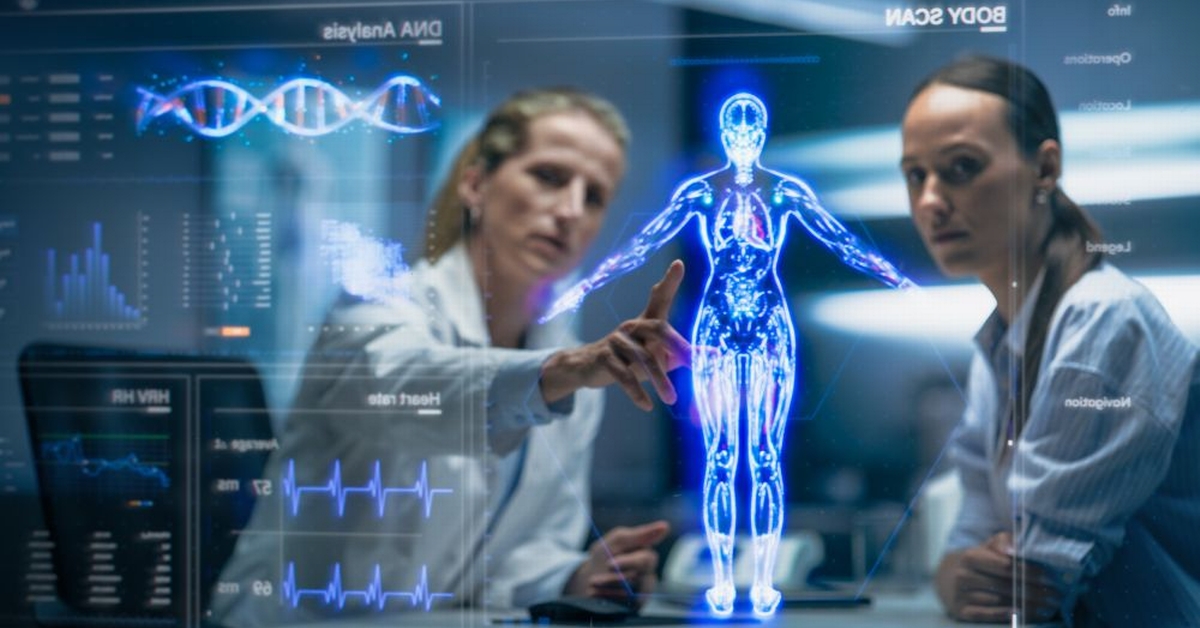
 Digital twins — virtual replicas of real-world assets and processes that update and evolve with data from the physical world — have been instrumental in optimizing operations and enabling predictive maintenance in manufacturing, reducing risk and increasing efficiency throughout the product lifecycle. The technology has moved far beyond its origins in engineering and manufacturing and is emerging as a powerful tool in healthcare as well.
Digital twin technology in healthcare combines data integration, advanced simulation, and artificial intelligence to improve patient care, optimize hospital operations, and accelerate medical innovation. They can range in scope from an individual organ model that helps plan complex interventions to large-scale simulations of hospital capacity and staffing. By continuously integrating real-time clinical data with predictive analytics, these models provide clinicians, administrators, and researchers with actionable insights that are difficult or impossible to glean from traditional tools alone.
What Is a Digital Twin in Healthcare?
In engineering, a digital twin is a virtual representation of a physical asset or system that incorporates live or periodically updated data to mimic behavior and performance. In healthcare, this concept is applied to biological systems, clinical workflows, and entire care environments. A healthcare digital twin might combine electronic health records, imaging data, vital signs from monitoring devices, genomics, and other biosignals to create a dynamic model that reflects a patient’s physiology or a hospital’s operations.
These virtual models support simulation, prediction, and optimization. For example, they enable what-if exploration — simulating how a patient might respond to different treatment strategies or how a hospital might manage a sudden surge in patient volume. The goal is to use data-driven tools to enhance clinical decision-making, personalize treatments, and improve system efficiency.
Patient-Specific Digital Twins: Precision and Predictive Care
One of the most compelling applications of digital twins in healthcare is in the realm of individualized patient modeling. Siemens Healthineers is among the organizations exploring this field with concepts such as the digital patient twin, which integrates diverse health data to build a continuously updated model of an individual’s physiology. In principle, such a twin could help clinicians understand disease progression, compare a patient’s trajectory against population data, and design more tailored treatment plans.
Digital replicas of organs — particularly the heart — have been used in clinical and research settings to simulate responses to therapy. For example, models built from magnetic resonance imaging (MRI) and electrocardiogram (ECG) measurements can simulate cardiac mechanical and electrical behavior to visualize how treatment choices might impact outcomes before a real intervention is attempted, reducing risk and improving planning.
In peer-reviewed scientific studies, cardiac digital twins at scale — built from large cohorts of MRI data — are helping researchers understand how factors like age, body size, and lifestyle affect heart function across populations, with potential implications for personalized diagnostics and preventive care.
Hospital Operations: Digital Twins for System-Level Optimization
Beyond individual patient modeling, digital twins are being deployed to optimize complex clinical systems. GE HealthCare has developed a purpose-built digital twin platform for hospitals and health systems that simulates real-world patient flows, staffing demands, and resource utilization. Unlike traditional planning tools that rely on averages, these twins capture the variability and interdependence inherent in healthcare systems — such as how changing an emergency department schedule affects downstream units like intensive care or surgical recovery.

Get the Training You Need for a Safer Workplace!
Autonomous mobile robots are one of the fastest-growing segments of the robotics industry. During this live virtual training, you’ll be introduced to safety protocols and best practices for working with mobile robots in industrial settings.
Learn more and register now for upcoming training dates.
Hospitals using digital twin simulations can run scenario analyses — for instance, exploring how seasonal patient surges will impact capacity, how different staffing allocations influence wait times, or whether investments in new facilities provide the best trade-off between access and cost. Because these models can be updated with fresh data, leaders can iterate rapidly on strategy rather than making decisions based on static assumptions.
AI-Driven Simulation and Autonomous Imaging
NVIDIA, a foundational provider of artificial intelligence (AI) infrastructure and simulation platforms, is advancing how digital twin technology supports simulation and autonomy in clinical workflows. In collaboration with GE HealthCare, NVIDIA has been developing the Isaac for Healthcare platform — a medical device simulation environment built on NVIDIA’s simulation, AI, and robotics computing stack. This enables developers to train and validate autonomous imaging capabilities (for example, automated patient positioning and image quality assessment in X-ray and ultrasound) in a virtual, physics-based environment before deploying to clinical hardware.
This work is part of a broader industry shift in which high-fidelity simulations leverage AI and physics-informed models to bridge the gap between digital design and physical deployment. By enabling virtual testing and validation, technologies like Isaac for Healthcare accelerate development cycles for imaging systems and robotics that must operate safely and effectively in real clinical settings.
Benefits Across the Care Continuum
Digital twin technologies in healthcare promise a range of benefits:
- Personalized clinical planning: Twin models help tailor therapeutic strategies by simulating individual physiological responses, potentially reducing trial and error in treatment selection.
- Risk mitigation in surgery: Virtual models allow surgeons to rehearse procedures and anticipate complications in patient-specific anatomical contexts, improving safety and outcomes.
- Operational efficiency at scale: Hospital twins optimize workflows and resource utilization, reducing bottlenecks and improving patient throughput.
- Innovation acceleration: Simulation environments reduce reliance on physical trial-and-error development for imaging systems and robotic assistants.
Challenges and the Road Ahead
Despite rapid progress, digital twin adoption in healthcare still faces challenges. Creating and maintaining accurate models requires high-quality, interoperable data sources — from electronic health records (EHRs) and imaging systems to wearables and biosensors. Privacy and consent are critical, given the sensitive nature of health data. Additionally, integrating digital twin insights into clinical workflows demands careful attention to usability and clinician acceptance.
However, as infrastructure, interoperability standards, and AI methods continue to improve, digital twin technology is poised to become a foundational component of precision medicine and healthcare system optimization. With major technology players advancing real-world applications — from digital patient twins to hospital capacity models and autonomous imaging simulations — the next decade looks set to bring these tools from promising research to everyday clinical impact.
Digital twin technology in healthcare is no longer just a futuristic concept. It is already being applied to predict patient outcomes, optimize clinical operations, accelerate medical device development, and personalize care in ways that were previously impossible. As these technologies continue to mature and scale, they promise a future in which healthcare becomes more predictive, more precise, and more efficient — ultimately improving outcomes for patients and providers alike.
link